On most days the four miles of hiking trails at Brinton Brook Sanctuary are quiet. Birders walk them on the second Saturday of every month, following the tradition Saw Mill River Audubon has maintained for decades. The brook itself runs cold and clear through mature hardwood forest, past meadows, wetlands, and a small pond before joining the Croton River just south of the New Croton Dam. There are no facilities — no visitor center, no gift shop, no paved parking. The sanctuary's 156 acres preserve what the land around Croton used to look like before suburban development transformed the Lower Hudson Valley.
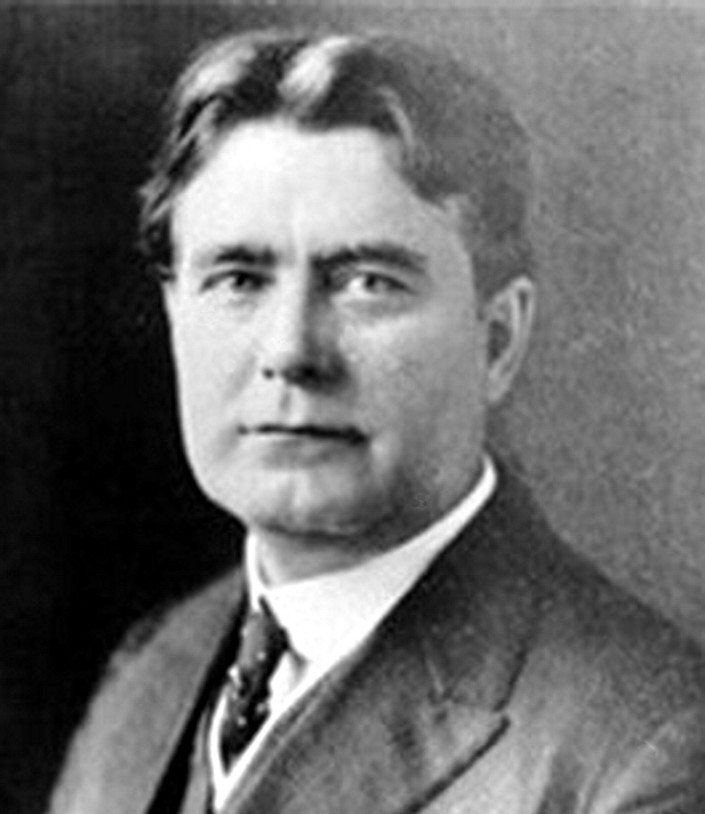
The name on the sign is unexpected. Not an indigenous word, like Kitchawank or Senasqua. Not a Dutch patroon family, like Van Cortlandt or Philipsburg. Not a dam engineer or a Gilded Age estate builder. The sanctuary is named for Willard Cope Brinton — a Harvard-trained mechanical engineer who became one of the founding figures of modern information visualization.
Most people who walk the trails have never heard of him. But the reason the sanctuary exists at all — and the reason it bears his name — is a story about grief, memory, and the quiet act of giving a place of refuge to the public forever.
The Engineer Who Invented a Language
Willard Cope Brinton was born on December 22, 1880, in West Chester, Pennsylvania (West Goshen Township, Chester County). His parents were Samuel Lewis and Elizabeth (Smith) Brinton — a Pennsylvania Quaker family with roots going back to the colonial era, living in a family home called "The Lindens." He had a brother, Clement B. Brinton. He prepared for college at the State Normal School in West Chester, Pa. and went to Harvard, graduating with a BS from the Lawrence Scientific School in 1907.
His first job out of school was with the Westinghouse Electric and Manufacturing Co. in East Pittsburgh. In the 1913 Harvard Sexennial Report he described what he had done there in his own words:
<em>"After graduation went to Pittsburgh with the Westinghouse Electric Co. Spent three years there in interesting special work, involving engineering and executive problems in every department of the works. Planned and installed a new building, arranged to treat by special processes some eighty kinds of by-products."</em>
From Westinghouse he jumped to the United States Motor Company in the fall of 1910, recommending "the best commercial utilization of thirteen plants for the manufacture of automobiles" — work that earned him an appointment as assistant to the vice president in the manufacturing department. A year later he resigned to take a position as mechanical engineer at the Bush Terminal Company of Brooklyn, where he was "designing and installing several new types of electrical machinery for the rapid and economical handling of steamship and railroad freight in the biggest and best plant of its kind in the world."
By 1913, sidework was becoming his real work. He was writing a series of articles on graphic statistics for Engineering Magazine. A book called Graphic Statistics — later retitled Graphic Methods for Presenting Facts — was "about ready to go to press" with "over one hundred and fifty charts and diagrams." And he had founded the Statistical Bureau in the Transit Building at 7 East 42nd Street:
<em>"A group of men who believe thoroughly that facts can be presented more vividly by diagrammatic methods have organized the Statistical Bureau, with office in the Transit Building, 7 East 42d St., New York. The business is rather general in scope, but especial attention is paid to the operating records and financial reports of industrial corporations and railroads."</em>
Germany, China, and a Day as a Spy
The four years after the Statistical Bureau's founding took Brinton to Europe and Asia, and he wrote about the trips with unusual vividness in his 1917 Harvard Decennial Report. The ASME "chartered the whole steamer Victoria Louise" of the Hamburg-American Line in June 1913 for a tour of German industrial works. Brinton went along — but he remembered it less for the factories than for the dining rooms: "I had enough of German banquets on that trip to be sufficient for a lifetime." At the close of the official trip he visited a friend who was chief engineer of the Italian Westinghouse Company near Genoa, then spent a month touring the harbors of continental Europe and England. The European harbor study "resulted in the development of some special freight handling machinery" — the work that would later underpin his 1921 proposal creating the Port of New York Authority.
Then, in 1915 or 1916, a client sent him to China:
<em>"Immediately afterwards work for another client involved a trip to China in the quickest possible time, going and returning on the same steamer so that I was in China only ten days. If this were an illustrated report I would insert a photograph showing a crusade through Soochow on donkey back with both feet dodging the ground. Among various incidents of the trip were a Japanese banquet in stocking-feet sitting on the floor, partaking of raw fish, etc., and a day under investigation as a spy because of my interest in taking photographs of freight handling facilities in a Japanese harbor."</em>
This is the only moment in Brinton's entire written record where we see him as a character rather than as a chart — a tall American on a donkey with his feet scraping the ground, arrested briefly by Japanese authorities for photographing a port. On the trip home he climbed Mt. Rainier, rode horses for two days in Arizona, and took a swim in Lake Michigan. He also met two other Harvard men in Shanghai, because as he put it: "It seems to make no difference in what part of the world one travels, one finds Harvard men."
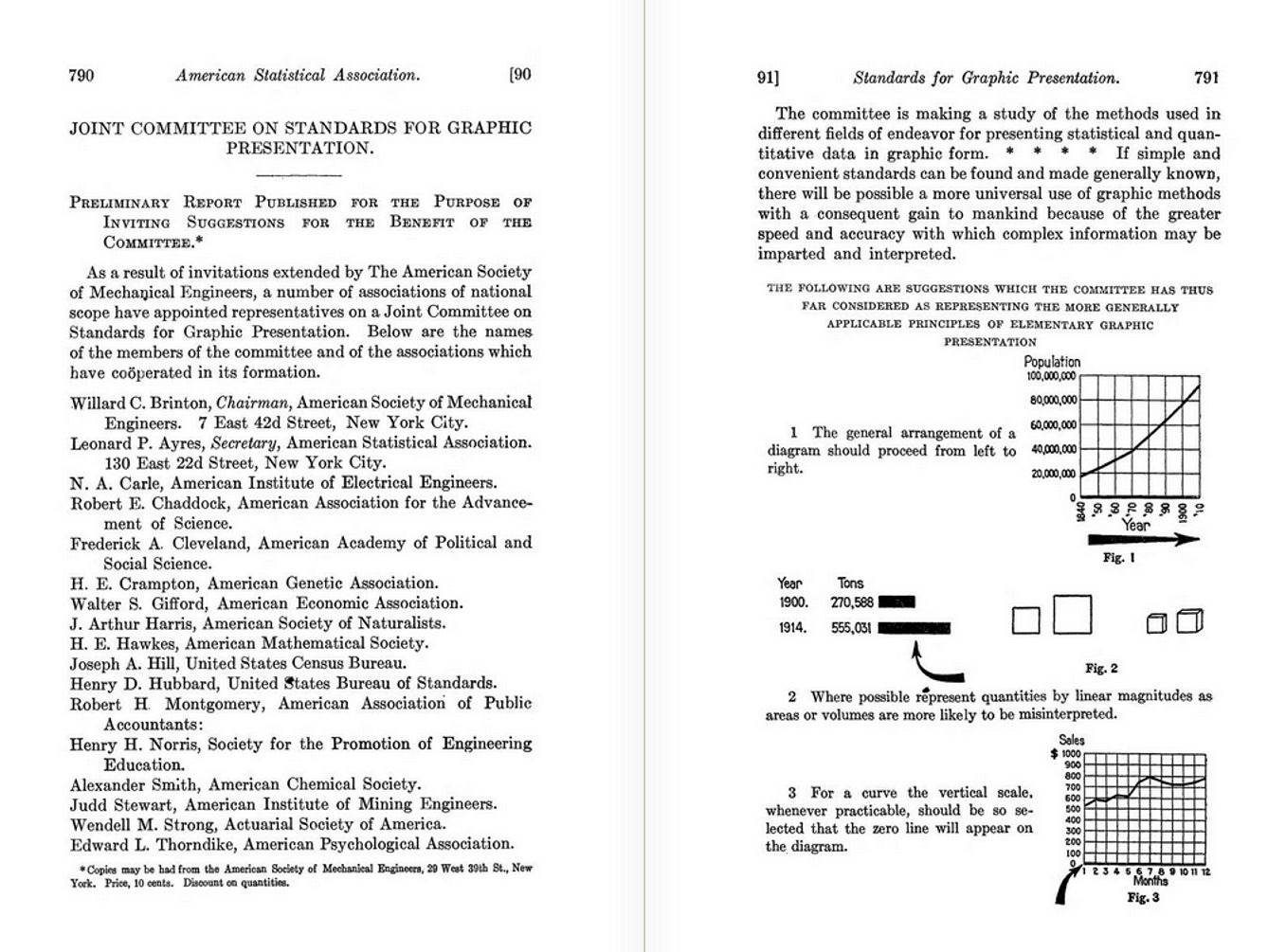
By 1917 Brinton was president of both the E. V. Lawrence Safety Brake Company and the Terminal Engineering Company. His book Graphic Methods for Presenting Facts (1914) was, according to its publisher, "the best selling book that they have ever printed." He had been lecturing at the Harvard Business School, Dartmouth Business School, and University of Chicago Business School. And he was chairing the Joint Committee on Standards for Graphic Presentation — "composed of one representative from each of nineteen American scientific societies of national scope." He was still unmarried, still living at the City Club of New York, 55 W. 44th Street. The Croton country house was still three or four years away.
He then went to work in industrial consulting at a time when American industry was growing so quickly that managers could no longer hold the numbers in their heads. Factories were tracking dozens of variables — production rates, worker hours, inventory levels, shipping schedules, quality defects — but there was no standardized way to see all that information at once.
In 1914, Brinton published Graphic Methods for Presenting Facts, widely considered the first American textbook on what we now call data visualization. It was a landmark. At a time when most business reports were columns of numbers on ledger paper, Brinton laid out a complete vocabulary of charts: bar graphs, line charts, pie charts, scatter plots, time series, maps overlaid with statistical data. He did not invent most of these individually — Playfair had drawn bar charts in the 1780s, Minard had famously mapped Napoleon's retreat in 1869 — but Brinton systematized them. He showed which kind of chart worked best for which kind of question, and he argued, forcefully, that clarity of presentation was not a nicety but a requirement of honest thinking.
"A tremendous advance has been made in recent years in the use of graphic methods for presenting facts," he wrote in the preface. "Those who do not know how to read graphic charts will soon be as handicapped as those who do not know how to read and write."
He followed it in 1939 with Graphic Presentation, an even more ambitious work that ran to 526 pages. Between the two books, Brinton essentially defined the field for a generation. Both books were scanned by the Internet Archive in the early 2000s and are now freely available online in full — his 1914 volume has been digitized multiple times, and the Wikimedia Commons category "Graphic methods for presenting facts, 1914" contains 13 high-resolution extracts of his original charts.
The Joint Committee on Standards for Graphic Presentation, which he chaired in 1915 (not 1913, as some sources claim), produced the first American standards for how charts should be drawn. Their report was published in December 1915 in Publications of the American Statistical Association, volume 14, issue 112, pages 790-797. Leonard P. Ayres served as Secretary. A surviving photograph of the committee — Brinton and his colleagues posed around a table — is preserved on Wikimedia Commons.
Brinton was Vice President and Director of the American Statistical Association in 1917 and served as president of the Harvard Engineering Society in 1932. He was a member of the Newcomen Society. He held patents for a siphon (US 1,496,366), a freight-handling apparatus (US 1,524,473), a freight shed (US 1,566,521), an object-holding rig for trucks (US 1,720,204), and guards and curtain closure devices (US 1,725,750) — all assigned to the Terminal Engineering Co. of New York, where he was a principal. He contributed to the 1921 proposal that created the Port of New York Authority, based on his studies of European harbor operations for the Bush Terminal Company.
And somewhere in all of that — between the chart committees and the consulting work and the patents — he and his wife Laura bought a wooded property along a small brook in Croton-on-Hudson and made it their country retreat.
The Country Retreat
The Brintons' Croton property was not a grand estate. It was a working forest with a stream running through it, the kind of land that wealthy New Yorkers bought throughout the 1920s as railroad lines made weekend escapes possible. The Croton-Harmon station on the New York Central line was a short trip from Grand Central. Willard Brinton could leave his Manhattan office on Friday afternoon, ride the train up the Hudson, and be walking his own woods before dark.
Willard married Laura MacDonald Moses on April 17, 1920, in New York City — Laura would later be listed in the 1930 U.S. Census as a "Designer, Pottery." His 1913 Harvard alumni directory listed his New York address as the City Club of New York, 55 W. 44th Street; by 1914-1916 he had moved his office to the Statistical Bureau at the Terminal Engineering Co., 7 East 42nd Street. The newlyweds bought the Croton land almost immediately. We know this because Brinton wrote about it himself.
In the 5th Harvard Class Report (Quindecennial, 1922), published on the fifteenth anniversary of his graduation, Brinton submitted one of the most vivid autobiographical statements in his entire written record. The Croton property appears in his own voice:
<em>"Recreation time has been, during the last year or so, largely devoted to getting into reasonable shape one hundred acres or so of Westchester County hills at Croton-on-Hudson, having one of the best views of the Hudson River and the Highlands. During 1920 my wife and I climbed Mt. Mitchell, N. C., and did some horse-backing in the Big Horn Mountains of Wyoming. We motored across eastern Oregon and hunted up a mine in California near the Mexican border."</em>
That one paragraph contains almost everything we know about Brinton's personal life away from charts and engineering. He and Laura had climbed Mt. Mitchell — at 6,684 feet the highest peak east of the Mississippi — on their honeymoon year. They went horseback riding in Wyoming. They drove through Oregon. They visited a mine near the Mexican border. And by 1921-22, he was putting weekends into "getting into reasonable shape" approximately 100 acres of Westchester County hills above the Hudson — the parcel that would become Brinton Brook Sanctuary. Brinton had the property in hand within roughly a year of his marriage, not in 1925 as earlier sources had estimated.
What did Brinton think about the woods? The Harvard Quindecennial passage is as close as he came to writing about nature. There are no published field notes, no photographs of him holding binoculars, no diaries. But his professional life was about seeing clearly — about stripping away confusion to reveal the underlying shape of a thing. That impulse must have extended to the way he thought about his forest. A birder takes a hundred small observations and builds them into an understanding of a place. So does a statistician. Brinton did both.
Brinton's Briarcliff-Peekskill Parkway Map
Brinton's engagement with the Croton landscape was not purely recreational. In his 1939 book Graphic Presentation — his 526-page magnum opus — he included a small map that he had drawn to advocate for a specific piece of local infrastructure. The map was printed on a postcard, and showed, in a heavy dashed line, the route of a proposed parkway crossing the Croton Dam. Brinton wrote:
<em>"This map in convenient form was of great assistance in securing adoption of the route now called the Briarcliff-Peekskill Parkway which includes 2300 acres of forest reserve. The line of dashes, purposely made heavy, indicates a direct route which is the natural extension of the Sawmill Valley Parkway. Words alone would have presented a less striking argument."</em>
What he is describing is the highway we now know as the Taconic State Parkway, specifically the section built as the Briarcliff-Peekskill Parkway. Brinton had drawn a chart to lobby for it — and he credited the chart, in his own book, with helping secure the route's adoption. This is the only documented instance of Brinton using his graphic-presentation methods for local Westchester County political advocacy. It was his own region, crossing his own dam. He wanted the parkway built, he made a map, and the map worked.
He died suddenly at his Croton-on-Hudson home on November 29, 1957, at the age of 76. The New York Times death notice the next day read: "BRINTON — Willard Cope, loving husband of Laura M. Brinton, suddenly on Nov. 29; also survived by brother, Clement B. Brinton." His ASME Memorial Obituary, published in the March 1958 issue of Mechanical Engineering (Volume 80, Number 3), listed his full professional career — Harvard 1907, ASME membership from 1907/1912, the Bush Terminal Company European harbor studies that led to the Port of New York Authority recommendation, his patents in materials handling and production control, his two books, and his 1932 presidency of the Harvard Engineering Society.
The Memorial Gift
Laura Brinton outlived her husband. In the aftermath of his death — at a time when many widows of that era would have sold country property to settle an estate — she made a different decision. She donated the 112 acres to the National Audubon Society as a memorial to Willard. The gift was explicit: the land was to be preserved as a wildlife sanctuary, in his name, forever.
The timing matters. 1957 was the moment when modern American environmentalism was just beginning to find its voice. Rachel Carson's Silent Spring would not be published for five more years. The Wilderness Act was seven years away. The Endangered Species Act was sixteen. In 1957, the idea of permanently protecting private land for wildlife — not as a state park, not as a federal reserve, but as a gift to an NGO with a mandate to manage it for conservation — was relatively novel in the Lower Hudson Valley.
Laura Brinton's memorial gift was quiet. It did not make headlines. But it placed one of the most beautiful properties along the Croton River under permanent protection at a moment when suburban development was rapidly transforming Westchester County. Within a generation, virtually every other comparable parcel would be subdivided into house lots.
The National Audubon Society, in 1958, assigned management of the new sanctuary to the newly formed Saw Mill River Audubon chapter — a local all-volunteer group that had been founded in 1953 by a handful of birdwatchers in northern Westchester. Brinton Brook became the chapter's first major sanctuary.
The Sanctuary Grows
In 1975, Ruth Brinton Perera, the Brintons' niece, added an additional 17 acres to the sanctuary. Her gift continued the family tradition — not just preserving the memory of her uncle, but expanding the territory that bore his name.
In 1991, the National Audubon Society transferred full ownership of the original 112 acres to Saw Mill River Audubon. The local chapter had proven it could manage the property responsibly; the national organization stepped back and let the volunteers take full responsibility. This was a significant shift. It meant the sanctuary was no longer a satellite of a national bureaucracy but the beating heart of a local conservation community.
In 1995 and 1998, the Village of Croton-on-Hudson added a 27-acre parcel adjoining the sanctuary, managed jointly with Saw Mill River Audubon via the Coyote Trail. This linked Brinton Brook to the village's trail system, allowing walkers to move seamlessly from municipal woods into the Audubon sanctuary and back again.
The total reached 156 acres — making Brinton Brook the largest sanctuary in the Saw Mill River Audubon system.
What the Sanctuary Holds
Walk the four miles of trails and you see why the land was worth preserving. Brinton Brook itself runs through a steep ravine before opening into meadows. The pond at the center of the property attracts wood ducks and great blue herons. The mature hardwood forest — red oak, sugar maple, American beech — supports migrating warblers every spring and fall. Saw Mill River Audubon's Second Saturday guided bird walks, a tradition dating back decades, have documented over 150 species on the property.
The sanctuary sits in a critical ecological position. To the north, the New Croton Reservoir and its wooded watershed provide thousands of acres of protected habitat for New York City's water supply. To the south, the Croton River enters the Hudson at Croton Point, where the Westchester County Park Commission has preserved the peninsula. To the east, the Old Croton Aqueduct State Historic Park runs in a 26-mile linear corridor. Brinton Brook connects these larger preserves — a stepping stone for wildlife moving through an otherwise heavily developed landscape.
From the Hudson River overlook, you can see Haverstraw Bay and, on clear days, the Palisades. The view has not changed substantially since Willard Brinton walked these trails. That is not an accident. It is the direct result of a widow's decision in 1957 to turn grief into permanence.
The Brinton Legacy
There is a quiet irony in the fact that Willard Cope Brinton — the man who spent his career teaching America how to present information visually — is remembered most durably not by a chart or a textbook but by a brook running through a wooded sanctuary. His books are studied by historians of statistics and design. They are out of print. The Croton sanctuary is open seven days a week, free, forever.
Laura Brinton's memorial gift is, in its way, a kind of graphic presentation. The woods are a chart of sorts — a visible record of what the land used to be, kept readable for future generations. The presentation is literal: walk through it, and you can read the watershed. The axes are trees and streams and bird calls. The data is the ecosystem itself.
Brinton would have understood.
Primary Sources (available online): - Brinton, Willard C. Graphic Presentation. New York: Brinton Associates, 1939. Internet Archive: https://archive.org/details/graphicpresentat00brinrich — 526 pages. Includes Brinton's own map of the Briarcliff-Peekskill Parkway crossing Croton Dam, with a caption crediting the map with helping secure the parkway's adopted route. - Harvard College Class of 1907 Secretary's Reports — the primary autobiographical statements Brinton submitted to his class, freely digitized at Internet Archive: - 1st Report (1908): https://archive.org/details/n01reportclass1907harvuoft — lists Brinton as Industrial Engineer, Westinghouse Electric, East Pittsburgh. - 2nd Report (1910): https://archive.org/details/n02reportclass1907harvuoft — "W. C. Brinton, 'The Lindens,' West Chester, Pa." - 3rd Report (Sexennial, 1913): https://archive.org/details/n03reportclass1907harvuoft — pp. 34-35; recounts Westinghouse, US Motor Co., Bush Terminal Co. work and the founding of the Statistical Bureau at 7 E. 42nd Street. - 4th Report (Decennial, 1917): https://archive.org/details/1907report04harvuoft — pp. 43-44; 1913 European trip with ASME, China trip on the same steamer, Graphic Methods for Presenting Facts (1914). Still "unmarried." - 5th Report (Quindecennial, 1922): https://archive.org/details/1907report05harvuoft — pp. 60-61. First Croton reference. Records April 17, 1920 marriage to Laura MacDonald Moses and describes "getting into reasonable shape one hundred acres or so of Westchester County hills at Croton-on-Hudson" during 1921-22. Primary source for dating the Brinton property acquisition. - 6th Report onward (1927-1957) — in copyright, not online. Held at Harvard University Archives, Pusey Library. - "Joint Committee on Standards for Graphic Presentation" — Publications of the American Statistical Association, Vol. 14, No. 112 (December 1915), pp. 790-797. Brinton as Chairman. JSTOR 2965153, available at https://archive.org/details/jstor-2965153 - ASME Memorial Obituary, Mechanical Engineering Vol. 80 No. 3 (March 1958). Full text: https://archive.org/details/sim_mechanical-engineering_1958-03_80_3 - Portrait of Willard Cope Brinton, c. 1920 — Wikimedia Commons (public domain): https://commons.wikimedia.org/wiki/File:Portrait_of_Willard_Cope_Brinton,_c._1920.jpg - Joint Committee on Standards for Graphic Presentation, 1915 — group portrait. Wikimedia Commons: https://commons.wikimedia.org/wiki/File:Joint_Committee_on_Standards_for_Graphic_Presentation,_1915.jpg - Brinton Patents (all US Patent Office, downloadable from Google Patents): US 1,496,366 (Siphon, 1924); US 1,524,473 (Freight-handling apparatus, 1925); US 1,566,521 (Freight Shed, 1925); US 1,720,204 (Object-holding rig for trucks, 1929); US 1,725,750 (Guards and curtain closure, 1929). - Wikimedia Commons Category: Graphic methods for presenting facts, 1914 — 13 high-resolution extracts of Brinton's original charts: https://commons.wikimedia.org/wiki/Category:Graphic_methods_for_presenting_facts,_1914
Secondary Sources: - Saw Mill River Audubon. "Brinton Brook Sanctuary." sawmillriveraudubon.org/brinton/ - Saw Mill River Audubon. "History of Saw Mill River Audubon." sawmillriveraudubon.org/history/ - Wikipedia. "Willard C. Brinton" (1880-1957) - Humantific. "ReAppreciating Willard C. Brinton." humantific.com/post/reappreciating-willard-c-brinton - Walter Grutchfield. "Meritex Ribbons / Terminal Engineering Co." waltergrutchfield.net/meritex.htm — preserves 1900/1925/1930 census records, 1918 draft registration, and the NYT death notice text - Wikidata Q18379795 — Brinton authority IDs (VIAF 20989646, LCCN n80117084) - National Audubon Society records, 1957-1991 ownership transfer - Village of Croton-on-Hudson, Coyote Trail agreement records (1995, 1998)