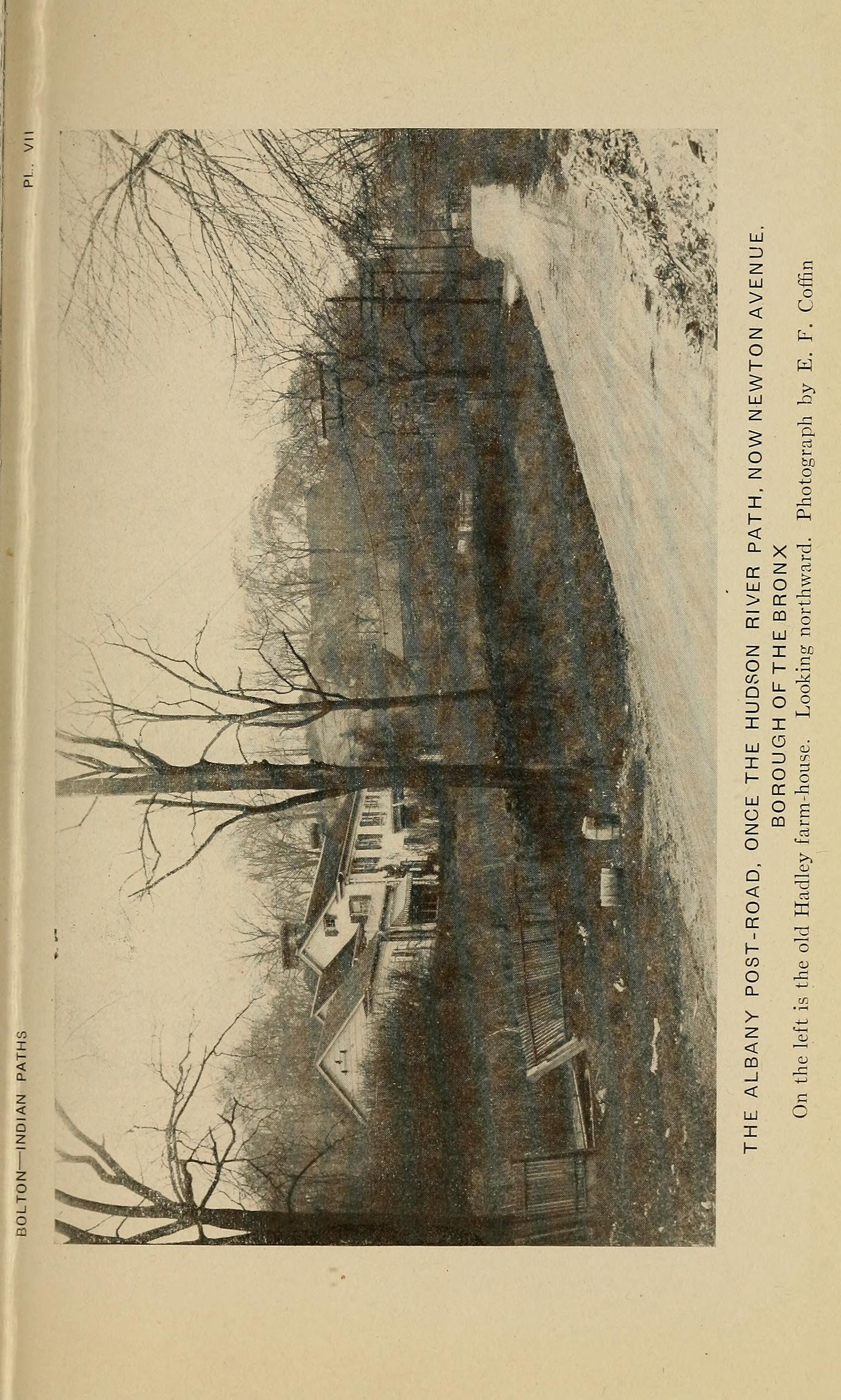
The standard story is that in 1776, with British tea scarce and expensive, a fleeing New York City grocer named John Arthur took refuge in northern Westchester and hoarded several chests of Bohea — a popular black tea from Fujian — hoping the price would rise before he sold it. Some thirty women from Dobbs Ferry, Tarrytown, Sleepy Hollow, and Sing Sing, led by one Madam Orser, learned of the stash. They rode out to the Arthur farm and laid siege to the house. Arthur's wife, his sisters-in-law, and the enslaved members of the household defended the tea with "tongs, pokers, spits, and broomsticks." Eventually Arthur negotiated — selling the tea at a fair price in exchange for a peaceful withdrawal.
The raiding party, according to Teatown's official history, called themselves the Daughters of Eve. Others called them the Daughters of Liberty. Either way, the area became known as "Teatown" after the incident.
That is the story that every child growing up in northern Westchester has heard. It is also the story that no contemporary document records.
The Problem with the Tale
The source for the Teatown tea raid is John M. McDonald, a Hudson Valley chronicler who spent the years 1844 to 1851 interviewing more than 400 people who had lived through the Revolution. He presented his findings to the New-York Historical Society on October 7, 1862. His interviews — conducted seven decades after the events they describe — form one of the most important oral history collections from the American Revolution in the Lower Hudson Valley, but they are also subject to the normal drift of memory across generations.
No 1776 document mentions a raid on John Arthur's farm. No contemporary newspaper, letter, or diary survives. The first written record is McDonald's interview notebook from the 1840s — a gap of seventy years during which the story was transmitted entirely by word of mouth.
In April 2025, the Westchester County Historical Society and Westchester County Archives digitized the entire McDonald Interviews collection and made it freely available online through CONTENTdm and New York Heritage. For the first time, the primary-source testimony for the Teatown tea raid is accessible to anyone with an internet connection. The key document is the interview with Talman Orser, conducted by McDonald on October 17, 1850 — available at collections.westchestergov.com/digital/collection/mcdonald/id/1020.
Talman Orser (1766-1862) was ten years old in 1776, old enough to remember the raid. By the time McDonald interviewed him he was 84. In the interview, Orser identifies the leader of the raiding party not as "Madam Orser" but by her full name: Elizabeth Pugsley Orser — Talman's own mother. He describes the gathering at Twitching's Corners in Mount Pleasant, the route the women took to reach the Arthur farmhouse, and the defense mounted by Dame Arthur and her household. Orser's deposition is the primary source that every later telling of the tea raid descends from — and the Westchester County Historical Society's 2025 digitization makes it possible, for the first time, to read what he actually said.
The Talman Orser interview is corroborated from an unexpected direction. On November 6, 1849 — almost a year before McDonald sat down with Talman himself — McDonald interviewed Samuel Washburn (b. ca. 1762) in the Town of New Castle. Washburn's interview is now WCHS item 1865, and it contains a specific instruction: McDonald should visit "Talman Orser in Ossining," described by Washburn as "the son of the Tea Captain." The editorial note added by WCHS archivist John English to the digitized interview explains that the "Tea Captain" reference points to Talman's mother Elizabeth Orser, "who led the group of women that secured a supply of tea from John Arthur." In other words: a second McDonald interviewee, talking to McDonald a full year before Talman himself, already treated the tea raid as a well-known episode, called Talman the "son of the Tea Captain," and pointed to his mother as the leader. The Washburn interview is independent corroboration — and it lets us date the oral-history transmission chain back even further than the 1850 Talman deposition alone would allow. If the story had been a later embellishment, Washburn would not have been spontaneously using "Tea Captain" as a nickname for Elizabeth Orser in 1849.
What the Manuscript Actually Says
Until now, every published account of the Teatown tea raid — from Teatown Lake Reservation's own history page to the Arcadia book by Lincoln Diamant — has relied on a synthesized version of the Talman Orser story. The handwritten 1850 notebook page, held at the Westchester County Historical Society, had been digitized in April 2025 but the 19th-century cursive was never transcribed. In 2026, as part of this history.croton.news project, we ran the manuscript page through Google's Gemini 3 Pro Preview vision model — one of the first times 1850s handwriting from the McDonald collection has been rendered as machine-readable digital text. What came back reshapes a few details of the standard account.
The opening of the interview as transcribed reads:
<em>"Oct. 17th Talman Orser, of Ossining, aged 82: 'There were four corners at Twitching's during the Revolutionary war formed by the White Plains and Pines Bridge Road and the [North Castle] Bedford and Tarrytown road near the Poor House was a road used before the Revolutionary war. I was born in the house where I now live. The Refugees under the Kipps, Saml. and James, used to come up and sweep off our cattle. Once they took off as many as 200 head of horses and cattle, and about twenty head from this place owned by my father...'"</em>
Three things stand out. First, Talman was 82, not 84, when McDonald interviewed him — a small correction to the standard sources. Second, Talman identifies "Twitching's Corners" as the specific intersection of the White Plains/Pines Bridge Road and the Bedford/Tarrytown Road, "near the Poor House" — placing the gathering point of Elizabeth Orser's raiding party at what is now the area of the Sprain Brook Parkway exit in Mount Pleasant. Third, and most striking for the history of the tea raid itself: the Orser family's experience of the Revolution was not really about the tea. It was about cattle. The Refugees under Samuel and James Kipp — the same Loyalist officers named in Samuel Washburn's 1849 interview — "used to come up and sweep off our cattle," taking as many as 200 head at a time including 20 from the Orser farm. The Teatown tea raid was one event in a long-running cross-border raid-and-counter-raid cycle between Orsers and Kipps. The raid on John Arthur's tea was a response — by a community that had been systematically stripped of its livestock — to a man they considered a hoarder and a profiteer.
That context does not appear in any published Teatown history. It required reading the actual handwriting of a man who was ten years old when the tea was taken, and 82 years old when he finally told McDonald what his mother had done and why.
In the 1970s, Lincoln Diamant — past president of Teatown Lake Reservation and author of the Arcadia Images of America volume on Teatown — investigated a competing theory: that "Teatown" was simply an English place name, brought over by early settlers the way so many other New York towns got their names. He wrote to the British Museum. A 1931 letter came back: "I have made a search of the various gazetteers, old and new, and have failed to discover any place in Britain bearing this name." Diamant concluded: "It's an indigenous American name."
That doesn't prove the tea raid happened. But it does rule out the most likely alternative. An 1868 F.W. Beers atlas of Cortlandt labels the area "Teatown," confirming the name was well-established by the mid-19th century. Whatever the truth of the John Arthur story, something about this place connected it to tea — and did so long enough ago that the association had become permanent by the time anyone bothered to write it down.
Before the Name
The land that became Teatown Lake Reservation was hunting and fishing territory of the Kitchawank — the Algonquian-speaking Wappinger-affiliated people who built the large fortified village of Navish at Croton Point, where oyster shell middens have been radiocarbon-dated to about 7,000 years ago. The Kitchawank moved seasonally across this landscape, following game and fish runs. To the south, the Sint Sinck — who gave their name to Sing Sing (now Ossining) — held the territory closer to the Hudson.
After European contact, the Kitchawank lost access to their lands through a series of coerced deeds in the 1640s–1680s. The Teatown area fell within the Van Cortlandt Manor, the vast patent granted to Stephanus Van Cortlandt in 1697. For most of the next two hundred years, it was a region of small farms — modest family holdings worked by yeoman farmers, interrupted only by the Revolutionary War and the later construction of turnpikes and railroads.
The Croft
In 1915, a wealthy Manhattan antiques dealer named Arthur S. Vernay purchased a parcel in the Teatown area from the Hershfeld estate and began building a Tudor mansion he called The Croft. The New York Herald described it as "probably the first completely antique Tudor house ever constructed in America." The building materials came from demolished English buildings — carved oak beams, leaded glass windows, a fireplace reputedly from the 14th century. Vernay, who also sold antiques and hunted big game in Africa, was creating an American country house that felt older than the country itself.
Daniel R. Hanna, son of the Ohio political boss Mark Hanna, acquired the estate next. In 1917 he built a stable and carriage house on the slope north of Spring Valley Road. That stable is still standing today — it is now the Nature Center and executive offices of Teatown Lake Reservation.
The GE President's Lake
In 1922 or 1923 (sources disagree), Gerard Swope bought The Croft and the surrounding estate. Swope (1872–1957) was the son of German-Jewish immigrants, an MIT graduate of 1895, and president of the General Electric Company from 1922 to 1940 and again from 1942 to 1945. He was also a labor reformer — the "Swope Plan" of 1931 was an influential proposal for business-labor cooperation during the Depression that helped shape the New Deal.
Swope renamed the estate Cliffdale Farm and ran it as a working country place. The Swopes rode horses through the surrounding woods, cutting many of the trails that Teatown visitors hike today. And then, around 1924, Swope did something that changed the land forever: he dammed Bailey Brook, flooding a low-lying meadow to create what is now Teatown Lake.
The lake is 42 acres. It is entirely artificial. When Swope's dam flooded the meadow, a small knoll remained above the waterline — surrounded on all sides by the new lake. That knoll is now Wildflower Island. It would become, decades later, one of the most remarkable botanical preserves in the Lower Hudson Valley.
Cliffdale Farm operated through the Depression and World War II as a largely self-sufficient estate. Eileen Argenciano, the daughter of the farm's superintendent, recalled later that the Swopes raised cattle, pigs, and chickens, and grew enough food that the estate could feed itself during wartime rationing. This was common practice among wealthy country-estate owners in the 1930s and 1940s — the country house was not just a retreat but a hedge against urban food shortages.
Swope died on November 20, 1957.
The Preserve Is Born
In 1962 or 1963 — the dates vary by source — the Swope heirs donated approximately 194–245 acres of Cliffdale Farm to the Brooklyn Botanic Garden as an outreach and education station. The donation directed the BBG to conserve the open space and educate the public. Teatown Lake Reservation began operating as a field station of the Brooklyn Botanic Garden in 1963, with a small staff and a growing community of volunteers.
In 1969 (or 1971, again depending on the source), Teatown formally incorporated as an independent nonprofit with a community board. It continued to lease the land from the Brooklyn Botanic Garden until May 18, 2018, when BBG transferred ownership to Teatown via a conservation easement — negotiated by then-executive director Kevin Carter. The land was finally, permanently Teatown's own.
Across the decades, the preserve grew. Adjacent properties were added as gifts and purchases. Today the reservation encompasses approximately 1,000 acres spanning four towns — Ossining, Yorktown, Cortlandt, and New Castle — with 15 miles of trails.
Wildflower Island
In the early 1980s, Warren Balgooyen, Teatown's first naturalist, paddled a canoe out to the small island in the middle of the lake. He discovered that the high ground — the knoll that had survived Swope's 1924 flooding — supported a natural community of native wildflowers that had not been grazed, mowed, or sprayed for decades.
Balgooyen and Marjorie Swope (Gerard Swope's daughter-in-law) began cultivating the island as a preserve for native wildflowers in 1982. It was formally dedicated in 1983 in memory of Louise Malsin. Jane Darby became its first curator.
Today, Wildflower Island covers 2 acres and contains more than 230 species of native and endangered wildflowers. It is reached by a wooden bridge from the mainland trail and is open to the public only on guided tours — a deliberate restriction that protects the fragile plant communities from foot traffic. Many of the species on the island are no longer found anywhere else in Westchester County. Wildflower Island is, in effect, a floating ark for the pre-suburban flora of the Lower Hudson Valley.
The Croft, Demolished
The Tudor mansion Vernay built in 1915 and Swope lived in did not fare as well as the land around it. Teatown acquired The Croft itself only in 2010, when Westchester County funding purchased the house and 67 surrounding acres. The cost of restoring and maintaining the building proved prohibitive. In February 2020, The Croft was demolished — the 14th-century fireplaces, the hand-carved oak beams, the imported leaded glass, all hauled away.
It is a kind of second loss. The land has been preserved in perpetuity; the house that held its early history has not.
What the Preserve Does
Teatown Lake Reservation today receives about 25,000 visitors per year. It runs environmental education programs for 10,000 participants annually, including 6,000 schoolchildren and 700 summer campers. It operates a Nature Center in the 1917 Hanna stable with live amphibians, raptors, and reptiles. It runs the Hudson River Eel Project, tracking juvenile American eels migrating up Bailey Brook from the ocean. It hosts the annual Hudson River EagleFest every February, in partnership with Croton Point Park, bringing thousands of people out to watch bald eagles wintering on the Hudson. It runs a spring plant sale that continues the horticultural legacy of Cliffdale Farm.
The preserve has become, in the decades since the Swope heirs' 1962 donation, the central outdoor education institution of northern Westchester County. None of this was foreseeable when Gerard Swope dammed Bailey Brook in 1924. He was just building a lake on his country estate.
The Name, Again
Teatown is an odd name for a preserve. It invokes a specific historical event — the 1776 tea raid — that may never have happened as told. It commemorates a grocer (John Arthur) who was neither a patriot nor a particularly sympathetic figure. It celebrates thirty women whose names are mostly lost except for Madam Orser, and even she may be a composite figure.
But perhaps that's appropriate. What Teatown preserves is not a historical moment but a landscape — hills and forests and a lake and an island of wildflowers — that survived because successive generations of owners and donors chose preservation over development. The name is a door. You walk through it, expecting a story about the Revolution, and what you find is the ecology of the pre-suburban Hudson Valley.
The tea was real, if the tale is to be believed. But the landscape is the legacy.
Sources Consulted
- Teatown Lake Reservation. "History." teatown.org/about/history/
- Wikipedia. "Teatown Lake Reservation"
- Wikipedia. "Gerard Swope" (1872-1957) — GE President
- Diamant, Lincoln. *Teatown Lake Reservation* (Images of America). Arcadia Publishing, 2002.
- Pilla, Dominick. "History of Teatown Preserve Explained." *North County News*, Dec 5-11, 2001.
- Croton Friends of History. "In Search of Teatown."
- Yasinsac, Rob. "The Croft at Teatown." Hudson Valley Ruins.
- Yasinsac, Rob. "Demolition of The Croft." Hudson Valley Ruins, 2020.
- McKinney, Michael P. "Teatown Lake Reservation...Land Protected." *Lohud/The Journal News*, May 2, 2018.
- Westchester County Government. "County Helps Protect 59 Acres Adjacent to Teatown."
- *Wag Magazine*. "Teatown's Wildflower Island: 'The Forest That Once Was.'"
- Cheshire, Marc. "Teatown, 1868" (F.W. Beers atlas detail). crotonhistory.org
- McDonald, John M. Interviews of 1844-1851. Presented to NY Historical Society, Oct 7, 1862. Digitized 2025 by Westchester County Historical Society & Archives: https://collections.westchestergov.com/digital/collection/mcdonald
- **Talman Orser interview (Oct 17, 1850)** — primary-source deposition on the tea raid: https://collections.westchestergov.com/digital/collection/mcdonald/id/1020
- Hufeland, Otto. *Index to the McDonald Interviews* (1920s). Digitized.
- 1931 letter from the British Museum to Lincoln Diamant regarding English place names
- Hudson Valley Ruins (Rob Yasinsac). "The Croft at Teatown." hudsonvalleyruins.org/rob/?p=2250
- Hudson Valley Ruins. "Demolition of The Croft." (2020) hudsonvalleyruins.org/rob/?p=2953
- Yorktown Historical Society archives. Eileen Argenciano oral history (Cliffdale Farm superintendent's daughter)
- Immigrant Entrepreneurship: "Gerard Swope" biographical essay — immigrantentrepreneurship.org/entries/gerard-swope/
- Gerard Swope Papers, MC-0155, MIT Department of Distinctive Collections (unpublished)
- Philip D. Reed Papers, Hagley Museum and Library (Reed was Swope's assistant and successor)
All direct quotes are verbatim from the cited sources. Each factual claim was verified against the Croton Historical Archive database.